


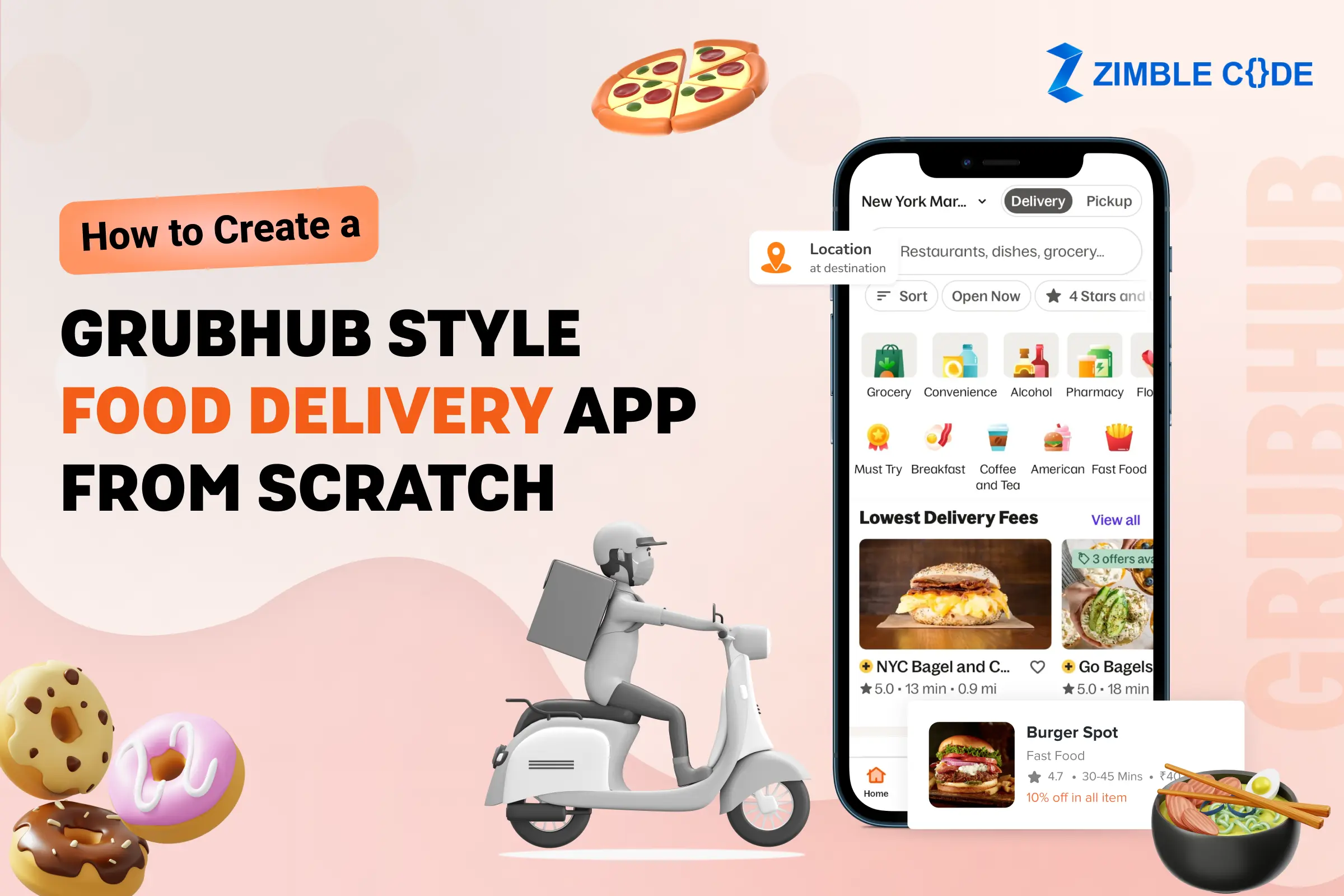
In 2025, food delivery has become an essential part of everyday life, driven by the rapid growth of on-demand services and digital-first dining habits. Consumers now expect faster deliveries, easy ordering, and real-time tracking, making advanced food delivery apps more important than ever.
At the same time, restaurants increasingly rely on aggregator platforms to reach customers, manage orders, and sustain revenue in highly competitive markets. Instead of handling logistics independently, many businesses prefer platforms that offer visibility, payment processing, and delivery coordination in one system.
Grubhub’s three-sided marketplace model continues to shape modern food delivery apps by connecting customers, restaurants, and delivery partners within a single ecosystem. Unlike single-vendor apps, this approach enables seamless ordering, efficient logistics, and centralized control, making it highly scalable and profitable.
In this blog, we will break down what a Grubhub-style food delivery app means and guide you through the key steps, features, and costs involved in building one from scratch in 2025.
Steps to Create a Grubhub-Style Food Delivery App
The Grubhub clone app development in New York requires a carefully planned process. As the platform connects multiple users in real time, every step must support usability, scalability, and reliable coordination across the ecosystem.
Step 1: Research the Market and Set Clear Objectives
Market research provides a strong foundation for development decisions. It aligns the app’s offerings with real customer demand, regional preferences, and business goals while reducing risks related to unnecessary or ineffective feature development.
- Identify Your Target Users
Understanding your audience is essential for meaningful feature planning. It reveals ordering habits, cuisine preferences, and delivery expectations, which helps design experiences focused on convenience, speed, and overall satisfaction.
- Study Competitors and Market Trends
Analyzing competitors provides insight into market gaps and service limitations. Therefore, these findings help Grubhub clone app developers to position your app with improved features, smarter pricing strategies, and better service differentiation.
- Define Your Revenue Strategy
A clear revenue strategy ensures long-term sustainability for the platform. Typically, income is generated through restaurant commissions, delivery fees, subscriptions, or promotional placements that support steady growth and predictable cash flow.
Step 2: Plan the Grubhub-Style App Structure
A well-organized app structure ensures smooth coordination between all user roles. In fact, the platform reduces operational confusion and supports efficient order movement by defining interactions clearly.
- Define User Roles and Interactions
Clearly defined responsibilities explain how orders move from customers to restaurants and delivery partners. As a result, workflows become predictable, delays are minimized, and service execution remains consistent.
- Establish the Admin Control Layer
A centralized admin system enables complete platform oversight. Consequently, administrators can manage users, monitor orders, oversee payments, and track performance while maintaining transparency and operational control in the custom food delivery app development.
Step 3: Decide on Features for Each App Component
Feature planning determines how practical and user-friendly the platform becomes. In fact, selecting only essential functionalities ensures simplicity and delivers meaningful value to customers, restaurants, delivery partners, and administrators.
- Customer App Features
Customer-focused features support restaurant discovery, order customization, secure payments, real-time tracking, and reviews. Consequently, these capabilities improve engagement and encourage frequent food ordering behavior.
- Delivery Partner App Features
Delivery-focused tools provide order alerts, navigation assistance, earnings visibility, and availability controls. Therefore, partners can manage deliveries efficiently while maintaining flexibility and consistent daily workflows.
- Restaurant Panel Features
Restaurant-focused features enable menu updates, order handling, inventory tracking, promotions, and performance insights. As a result, vendors improve operational efficiency and respond quickly to changing customer demand.
- Admin Panel Features
Administrative tools manage approvals, commissions, payments, disputes, promotions, and analytics. Consequently, platform owners maintain oversight, ensure compliance, and monitor overall system performance effectively.
Step 4: Design a Simple and Intuitive User Experience
User experience design directly influences engagement and retention. A clean and intuitive interface reduces learning effort, improves task completion speed, and ensures consistency across all user-facing applications.
- Create Clear User Journeys
Well-structured navigation allows users to complete tasks efficiently. Therefore, every interaction in an on-demand food delivery app development follows a logical sequence that builds confidence for customers, delivery partners, and restaurants.
- Develop Wireframes and Prototypes
Wireframes and prototypes visually represent app functionality before development. As a result, usability issues are identified early, reducing rework and ensuring consistent design execution.
Step 5: Select the Right Technology Stack
Technology selection affects performance, scalability, and long-term maintenance. Choosing reliable tools ensures real-time operations function smoothly while supporting growth and minimizing technical limitations.
- Front-end Development
Front-end development using cross-platform frameworks ensures consistent design and performance. Consequently, the app delivers a smooth experience across devices with faster updates and reduced development effort.
- Back-end Development
Back-end systems handle real-time communication and secure data processing. Using such systems, the Grubhub clone app development expert in New York can ensure reliable order management and seamless interaction between all app components.
- Database and Cloud Setup
Scalable databases and cloud infrastructure support growing traffic efficiently. As a result, the platform maintains stability during peak ordering periods.
- Third-Party Integrations
Third-party services add critical functionality such as payments, maps, and notifications. Consequently, users receive secure transactions and real-time updates throughout the ordering journey.
Step 6: Build the App Using an MVP Approach
An MVP approach reduces development risk while accelerating market entry. As a result, the platform gathers real user feedback before expanding features by releasing core functionality first.
- Focus on Essential Features
An experienced food ordering app development company in the USA focuses on the core features first that support ordering, acceptance, and delivery workflows. Therefore, the platform operates reliably from launch without unnecessary complexity.
- Use Agile Development
Agile development supports continuous improvement through short iterations. As a result, teams refine features efficiently based on real usage data and feedback.
Step 7: Test the App and Ensure Security
Testing ensures platform reliability and builds user trust. In fact, thorough validation identifies technical issues while protecting sensitive information across all interactions.
- Functional and Performance Testing
Testing confirms features work correctly under normal and peak usage. Consequently, users experience consistent performance during high-demand periods.
- Security and Data Protection
Security practices such as encryption and access controls protect user data. Therefore, trust is maintained while meeting modern data protection standards.
Step 8: Launch the App and Drive Adoption
A successful launch requires planning beyond development. In fact, strong onboarding and promotion help attract users and establish early platform engagement.
- App Store Deployment
Compliance with app store guidelines ensures smooth approval. Consequently, users can download and access the app without delays.
- Onboard Restaurants and Delivery Partners
Effective onboarding ensures service readiness at launch. As a result, users immediately access multiple restaurants and reliable delivery options.
- Promote the App Strategically
Strategic marketing through referrals, partnerships, and digital campaigns increases visibility. Therefore, downloads grow while encouraging long-term engagement.
How Much Does it Cost to Build a Grubhub Clone App in New York?
The cost to build a Grubhub-style food delivery app depends on platform complexity, feature depth, and technology choices. On average, a basic MVP that includes customer, restaurant, and delivery partner apps, as well as an admin panel, typically ranges from $70,000 to $100,000. On the other hand, a fully scalable solution with real-time tracking, AI-driven recommendations, advanced analytics, and secure third-party integrations can cost $130,000–$220,000. In fact, factors such as UI/UX design, third-party integrations, cloud infrastructure, security requirements, and ongoing maintenance also influence the final budget. Therefore, partnering with an experienced food delivery app development company in New York, USA, such as ZimbleCode, helps optimize costs while ensuring quality, scalability, and faster time-to-market food delivery solutions.
Frequently Asked Questions (FAQs)
Q1. How long does it take to build a Grubhub-style food delivery app?
A Grubhub-style app typically takes 4–7 months to build, depending on feature scope, integrations, and testing requirements.
Q2. Is it possible to customize the app for different regions or cuisines?
Yes, regional customization can be added through location-based menus, pricing rules, and localized promotions.
Q3. Is it possible to monetize the app beyond commissions?
Additional monetization options include subscriptions, featured listings, advertisements, and sponsored promotions.

Leave A Comment