


How do modern enterprises manage millions of users, complex workflows, real-time data, and seamless digital experiences at the same time?
The answer lies in enterprise web development, which has become the foundation of digital transformation in 2026. In fact, enterprise web applications help businesses streamline operations, improve customer experiences, and scale efficiently in competitive markets from enterprise SaaS platforms and eCommerce systems to healthcare portals and financial dashboards.
Unlike traditional websites, enterprise applications are built for high performance, advanced integrations, enterprise-grade security, and long-term scalability. Additionally, modern technologies such as cloud computing, AI integration, microservices, and API-first development are rapidly transforming how these applications are designed and managed.
This complete guide will explore enterprise web development in 2026, including its benefits, technologies, and development process.
Benefits of Enterprise Software Solutions
Enterprise digital transformation solutions help businesses improve efficiency, streamline operations, and manage complex workflows through centralized digital systems. These solutions automate repetitive tasks, reduce manual errors, and enable faster communication between departments, leading to improved productivity and smoother business operations. Additionally, custom enterprise applications can be modified according to specific business requirements, ensuring better alignment with organizational goals and operational processes.
Modern enterprise solutions also provide scalability to allow businesses to handle growing customer demands, increasing data volumes, and expanding operations without affecting performance. Furthermore, centralized data management helps organizations access real-time information, generate accurate insights, and make faster strategic decisions. In fact, advanced security features, including data encryption, role-based access, and compliance support, further protect sensitive business information and minimize security risks.
Enterprise software also enhances collaboration by connecting teams, systems, and processes within a single platform accessible across multiple devices. Although the initial investment may seem significant, these solutions help reduce long-term operational costs through automation, optimized resource utilization, and simplified maintenance. As a result, enterprise software solutions enable businesses to improve customer experiences, increase operational flexibility, and maintain a strong competitive advantage in rapidly evolving digital markets.
How to Build Scalable Enterprise Web Apps?
A scalable web application development requires a strategic approach that combines strong planning, modern architecture, secure development practices, and continuous optimization. In fact, a well-structured enterprise app development process improves flexibility, reliability, long-term maintainability, and overall digital transformation success.
1. Requirement Analysis and Planning
The first stage focuses on understanding business goals, operational challenges, and user expectations before development begins. In fact, teams gather requirements from stakeholders, define workflows, identify integrations, and determine compliance needs. At this point, businesses also select suitable technologies, estimate budgets, and create realistic timelines. As a result, proper planning reduces development risks, improves communication, and ensures the enterprise web application supports future scalability, security, and business growth effectively.
2. System Architecture and Web App Design
After planning, developers create the enterprise web application architecture and define databases, APIs, integrations, and cloud infrastructure. Modern enterprises increasingly adopt cloud-native and microservices-based architectures to improve scalability and flexibility. Simultaneously, designers build intuitive UI/UX interfaces that simplify navigation and enhance user engagement. Also, security features, including encryption, role-based access, and authentication systems, are integrated early to strengthen application reliability and support cloud-based enterprise applications efficiently.
3. Development
During the development stage, teams build both frontend and backend functionalities of the enterprise application. Developers use modern frameworks like React, Angular, Node.js, and Python to create responsive interfaces and scalable server-side systems. Additionally, API-first development and cloud integration improve flexibility across platforms and devices. Businesses also adopt AI-assisted coding tools and DevOps practices to accelerate development speed, improve productivity, and build high performance web applications capable of handling enterprise-level operations seamlessly.
4. Testing and Quality Assurance
Once development is completed, the application enters the testing and quality assurance phase to verify performance, functionality, and security. Teams conduct unit testing, integration testing, performance testing, cross-browser testing, and user acceptance testing to identify and resolve issues before launch. Moreover, enterprises now prioritize zero-trust security testing, automated QA processes, and continuous monitoring to ensure applications remain reliable, secure, stable, and capable of supporting enterprise SaaS development requirements effectively.
5. Deployment and Maintenance
In the final stage, the enterprise web application is deployed using automated CI/CD pipelines that support faster and more reliable releases. Businesses often use cloud platforms like AWS, Azure, and Google Cloud to improve scalability, availability, and disaster recovery capabilities. However, deployment is not the end of the process. Continuous monitoring, feature updates, security patches, performance optimization, and infrastructure improvements help enterprises maintain application efficiency and adapt to changing business requirements.
Technologies Used in Enterprise Web Development
Enterprise web development uses advanced technologies that improve scalability, security, flexibility, and performance for modern businesses, such as:
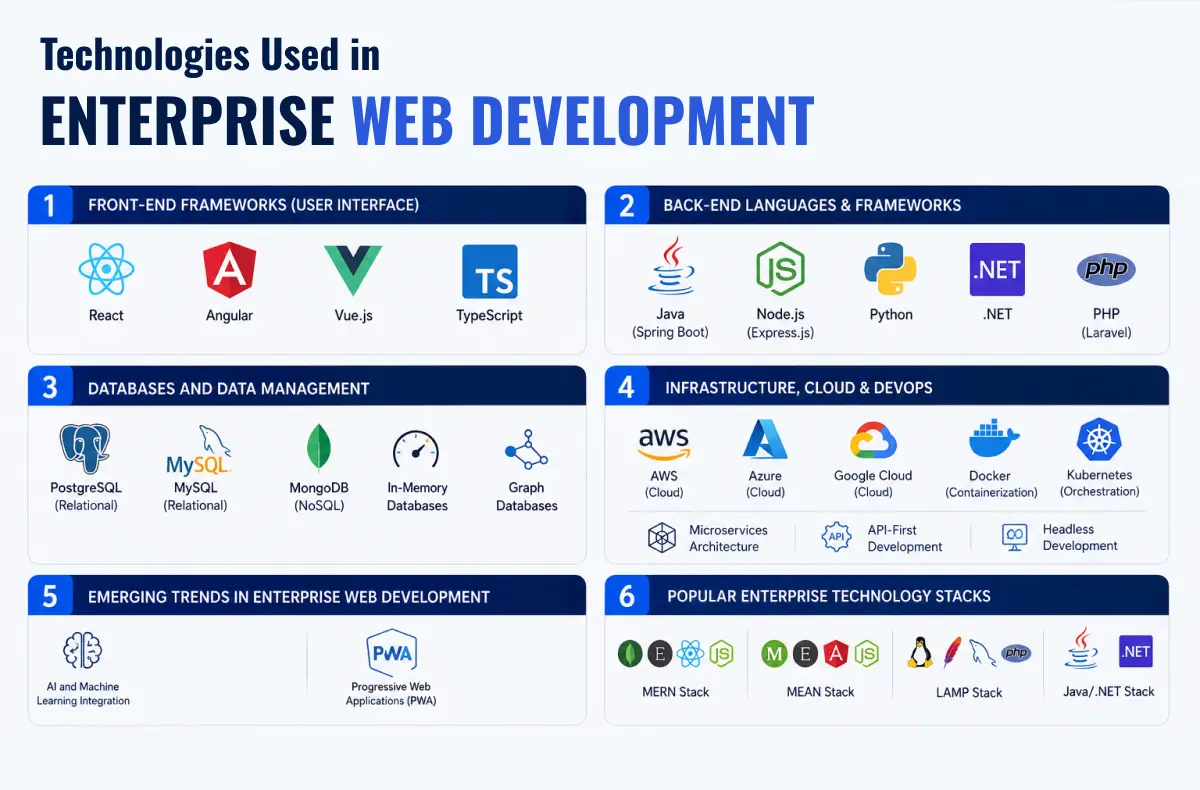
1. Front-end Frameworks (User Interface)
Frontend technologies help businesses create responsive, interactive, and visually appealing enterprise applications across multiple digital platforms. It includes:
- React: React helps developers create dynamic interfaces through reusable components and faster enterprise web app development processes.
- Angular: Angular provides structured development capabilities that improve scalability, maintainability, and performance for complex enterprise systems.
- Vue.js: Vue.js simplifies frontend development by delivering flexibility, faster performance, and smooth enterprise user experiences consistently.
- TypeScript: TypeScript improves code reliability by reducing errors and supporting maintainable enterprise application development processes efficiently.
2. Back-end Languages & Frameworks (Server-side)
Backend technologies manage business logic, databases, APIs, and integrations to ensure secure enterprise application performance. It comprises of:
- Java (Spring Boot): Java with Spring Boot supports secure, scalable, and reliable enterprise applications requiring advanced system stability.
- Node.js (Express.js): Node.js enables high performance web applications through real-time processing and scalable backend development capabilities.
- Python (Django/Flask): Python frameworks simplify scalable web application development by supporting automation, analytics, and AI-powered capabilities effectively.
- .NET: .NET provides strong security features and enables seamless integration with Microsoft enterprise business environments efficiently.
- PHP (Laravel): Laravel simplifies backend development by supporting flexible enterprise portals and scalable content management systems efficiently.
3. Databases and Data Management
Enterprise databases securely manage structured and unstructured information while supporting scalable and efficient business operations, such as:
- Relational Databases (PostgreSQL & MySQL): Relational databases securely organize structured business data and ensure reliable transactions and data consistency throughout.
- NoSQL Databases (MongoDB): MongoDB supports flexible enterprise data storage by handling large-scale and rapidly changing information efficiently.
- In-Memory and Graph Databases: These databases improve real-time analytics and support faster processing and advanced relationship mapping capabilities effectively.
4. Infrastructure, Cloud & DevOps
Infrastructure and DevOps technologies improve deployment speed, scalability, automation, and enterprise application management across environments. It includes:
- Cloud Platforms (AWS, Azure, Google Cloud): Cloud platforms provide scalable infrastructure and improve availability, security, and flexibility for cloud-based enterprise applications.
- Containerization (Docker & Kubernetes): Docker and Kubernetes simplify deployments and support efficient scaling and application consistency across environments.
- Microservices Architecture: Microservices improve enterprise flexibility and enable independent service management within large scale web application architecture environments.
- API-First and Headless Development: API-first development improves integrations and supports multi-platform enterprise experiences with faster development processes efficiently.
5. Emerging Trends in Enterprise Web Development
Modern enterprise technologies continuously improve automation, analytics, personalization, and digital experiences across business applications globally. It accounts for:
- AI and Machine Learning Integration: AI technologies automate enterprise processes and improve analytics for smarter custom enterprise applications and user experiences.
- Progressive Web Applications (PWA): PWAs improve enterprise accessibility by providing offline functionality and app-like experiences across devices seamlessly.
6. Popular Enterprise Technology Stacks
Enterprise technology stacks combine multiple technologies and simplify scalable enterprise application development processes.
- MERN Stack: MERN stack combines modern JavaScript technologies and supports scalable, responsive enterprise web application development efficiently.
- MEAN Stack: MEAN stack provides structured enterprise development and supports scalable applications with efficient backend integration processes.
- LAMP Stack: LAMP stack supports reliable enterprise websites and enables cost-effective, flexible web application development efficiently.
- Java/.NET Stack: Java and .NET stacks provide enterprise-grade security and support stable, scalable, and secure business applications effectively.
Why Choosing the Right Enterprise Software Development Company Matters
As businesses continue accelerating their digital transformation strategies in 2026, enterprise web applications are becoming essential for delivering connected, data-driven, and customer-focused experiences. However, long-term success depends not only on adopting advanced technologies but also on selecting the right development partner capable of understanding evolving business requirements, industry challenges, and future scalability goals.
A reliable enterprise software development company such as Zimble Code helps organizations build secure, adaptable, and future-ready applications that align with operational objectives and changing market expectations. In fact, the experienced team at Zimble Code ensures smoother execution, faster innovation, and sustainable business growth from planning and architecture to deployment and ongoing optimization.
Frequently Asked Questions (FAQs)
Q1. How long does enterprise web app development usually take?
Enterprise web app development timelines typically range from several months to over a year, depending on project complexity.
Q2. What is the difference between enterprise apps and SaaS platforms?
Enterprise applications are organization-specific, whereas SaaS platforms are generally designed for multiple businesses or users.








Leave A Comment